




Beauty or Beast? How the lionfish invaded the Caribbean

Hey scuba people! What fish do you signal by clasping both hands together as if you were praying, crossing your fingers, and moving them up and down, imitating its spine-like fins? If you dived in the Caribbean, you must be familiar with the infamous intruder in our waters: the lionfish.
With its distinctive white stripes, feathery pectoral fins, and vibrant coloration, the lionfish (Pterois volitans and Pterois miles) looks like a piece of art. Who would think that it is one of the most destructive invasive species ever brought by humans into the Caribbean…
Over the past few decades, lionfish have staged a quiet, rapid takeover of the Caribbean Sea, the Gulf of Mexico (yes, Mexico!), and the Western Atlantic, fundamentally changing fragile underwater ecosystems.
Lionfish are native to the warm coral reefs of the Indo-Pacific and Indian Oceans. That is where they belong and thrive, but human activity bridged that gap…
Something to remember here: it is our reckless or inadvertent doing that caused the lionfish drama in the Atlantic. Ask our instructor Jackie, she will tell you all about it…

It is believed that the invasion began off the coast of South Florida in the mid-80s. Marine biologists attribute the introduction to the exotic home aquarium trade. Aquarium owners who purchased lionfish often released them into local ocean waters when the fish grew too big, became too aggressive, or became too expensive to feed. Well... they could have just eaten them - as you will learn in a bit!
Once just a few specimens entered Florida's warm waters, strong Atlantic currents carried their buoyant egg masses across vast distances. By the mid-2000s, lionfish populations had exploded across Bermuda, the Bahamas, Cuba, and down into the entire Caribbean basin.

Why is it so bad, you’d ask? How can a fish that is an important part of the ecosystem in one ocean pose a threat in the other ocean?
An invasive species is a non-native organism that causes ecological or economic harm in its new environment. The lionfish possesses a unique biological toolkit that makes it an almost unstoppable super-predator:
A single female lionfish can release up to 2 million eggs per year, spawning every few days in warm tropical waters.
They possess 18 venomous spines along their dorsal, pelvic, and anal fins. Many native Atlantic predators do not recognize them as food and avoid them, so their population keeps growing.
A lionfish's stomach can expand up to 30 times its normal volume, allowing it to consume up to 90% of its body weight in prey daily.
Caribbean native species did not co-evolve with lionfish, so they do not recognize them as predators, allowing lionfish to corner and gulp them down effortlessly.
They do not have depth preference: they can thrive anywhere from shallow mangroves and seagrass beds down to depths exceeding 300 m (1000 ft).
How do these features impact the local Atlantic ecosystems?
Lionfish are not picky eaters: they feed on over 50 species of native Caribbean fish and crustaceans. Studies show that the arrival of a single lionfish on a coral reef can reduce the number of juvenile fish reaching the adult population up to 79% in just a few weeks. In simple terms, fish babies (collectively called fry) lack antipredator instincts against the nasty invader so entire generations of local species are wiped out before they reach maturity.
Lionfish have a particular taste in herbivorous fish though, such as parrotfish and surgeonfish. These herbivores serve as the cleaners of the reef, constantly grazing on algae to keep coral heads clean. When lionfish eliminate them, algae grows unchecked, smothering adult corals, blocking sunlight, and preventing young coral larvae from settling and growing. This speeds up reef degradation in ecosystems already weakened by pollution and rising ocean temperatures.
The threat extends beyond ecology and - as in Cozumel up to this day many families live from what fishermen bring home or sell on the market - we should talk about how lionfish impact local fishermen's daily catch. Lionfish compete directly with commercially important native species: snapper and grouper, while eating their juveniles. It affects fishermen's income directly - unless they move to hunting for lionfish instead of other species.
From a scuba diving and tourism perspective: even if lionfish might be an interesting sight during a scuba or snorkeling tour, they are eventually responsible for reducing the biodiversity of the reefs we visit. They also can pose a safety concern - they have venomous stings that may harm careless fishermen, swimmers, and divers.
If you went on any snorkeling tour around Cozumel or ate out in the local restaurants, you must have seen lionfish on the menu. You might have even had lionfish ceviche during your surface interval. You might have also seen divers and freedivers with Hawaiian slings hunting for lionfish on their dives. As a matter of fact, spearfishing is - at least as for now - the primary line of trying to control the lionfish population in many Caribbean locations.
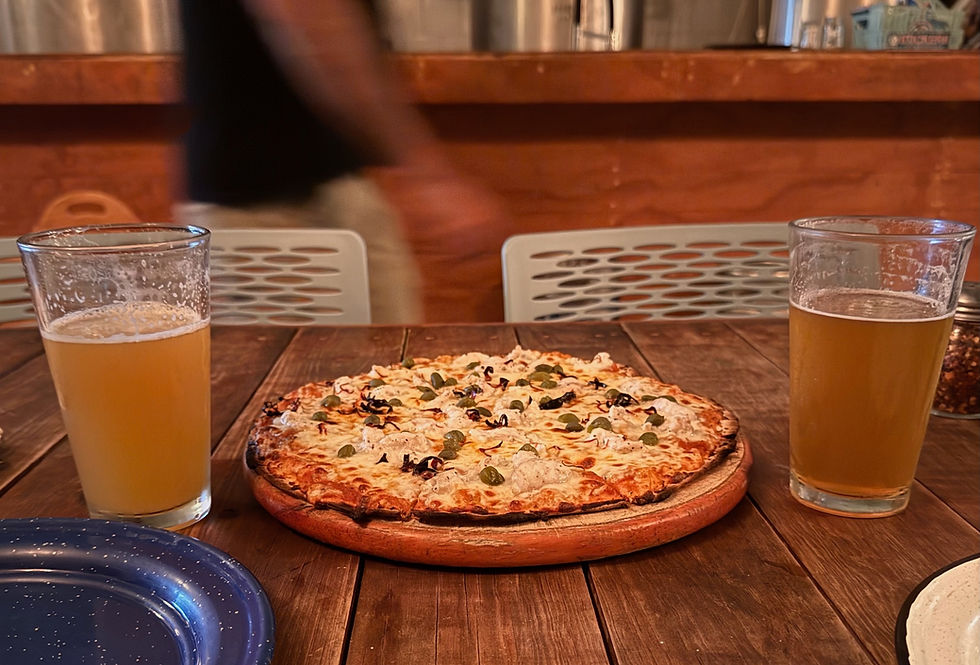
Fortunately, lionfish are very tasty! Their meat is white, flaky, and delicate. Once the venomous spines are safely removed, the flesh contains no venom and is completely safe to consume. Restaurants throughout the Caribbean serve lionfish ceviche, fish tacos, and other meals to boost up commercial harvesting. When on Cozumel, you cannot miss the famous lionfish pizza and ceviche from Cerveceria Punta Sur or the elegantly served lionfish entree at New Especias!
As the colouring of their scales is quite impressive, their skins are also used to produce jewellery - check out the earrings or bracelets from the Lionfish Caribbean based on Curacao! We have not seen yet lionfish scales used in any adornments sold on the local weekend market on the main square, so there is definitely some potential for business here!
Lastly, as you may ask - are lionfish exempt from the no-fishing policy in the Marine Park? The answer is - at least to our best knowledge - that no one, not even Marine Park guides, can go lionfish hunting without having participated in a program organized by the Marine Park authorities. According to our information, the local divers are first taught how to safely cull and transport the catch underwater so they can later on participate in lionfish hunting dives scheduled by the Marine Park. Outside of the Marine Park, lionfish hunting is legal and doesn’t require any special permissions though. However, it has to be done with the proper equipment (zoo-keeper!), skills, and respect for marine life.
Conclusions?
The lionfish invasion is a grim reminder of how rapidly human actions can alter ocean ecology. While complete elimination of the lionfish from the Caribbean is impossible, targeted culling, eco-conscious dive tourism, and consumer demand for lionfish as sustainable seafood/decorative element offer local reefs a critical fighting chance to adapt and rebuild.


Comments